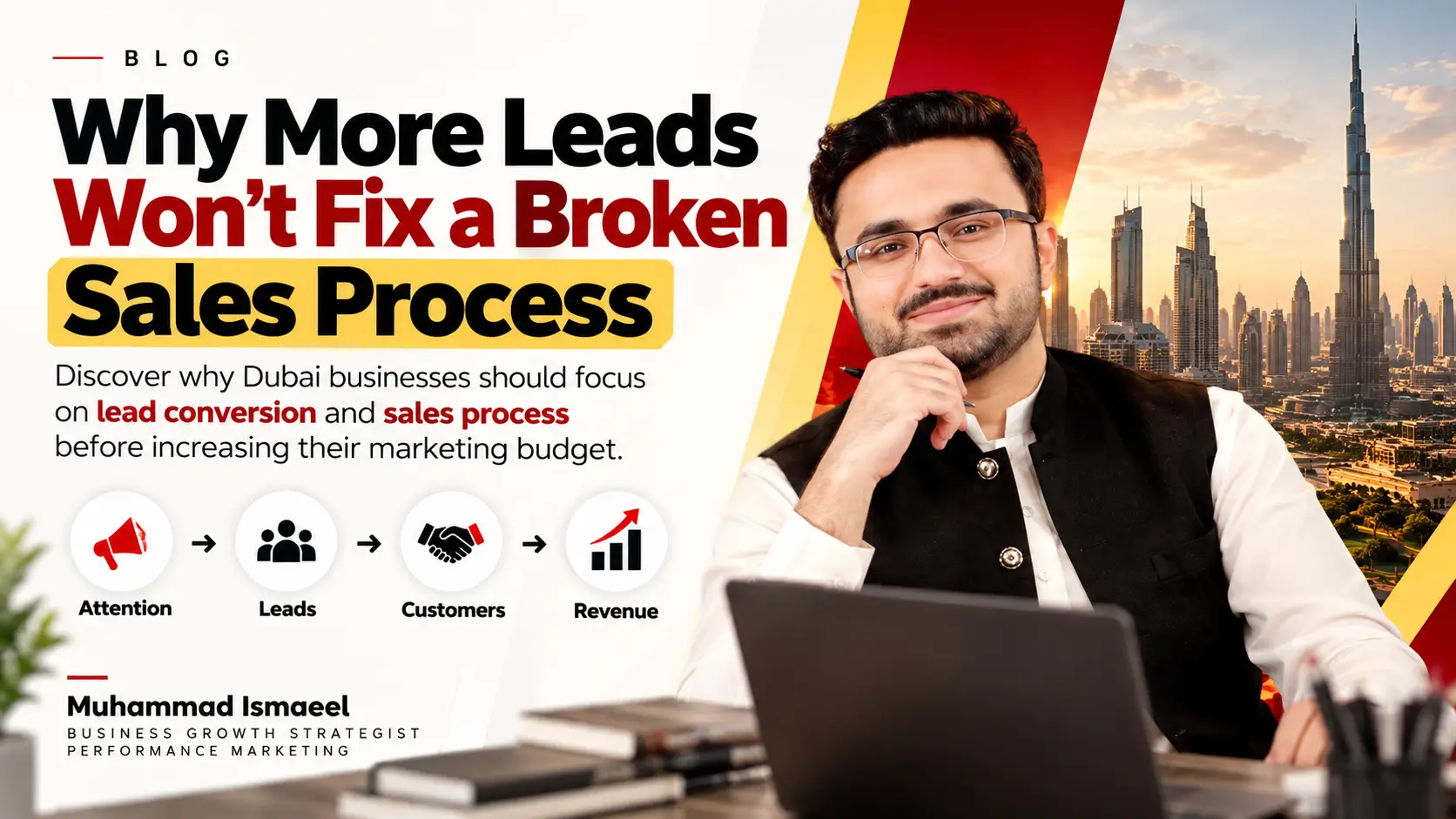
By Muhammad Ismaeel | Founder & Business Growth Strategist
More leads don’t always mean more sales. And more advertising doesn’t always mean more business growth.
This is something I believe every business owner in Dubai should understand before increasing their marketing budget.
Imagine running a home renovation company in Dubai.
You’re investing in Google Ads and Facebook Ads. People are visiting your website, sending WhatsApp messages, requesting quotations, and asking about your services.
Your marketing appears to be working.
But when you review your revenue at the end of the month, the numbers tell a different story.
You generated inquiries, but only a small percentage became paying customers.
Your first thought might be:
“We need more leads.”
But what if the real problem isn’t lead generation?
What if your business is losing potential customers after they’ve already shown interest?
This is where marketing strategy, sales conversion, and business growth become closely connected.
1. The Real Problem With Lead Generation in Dubai
Dubai is a competitive market for service businesses.
Whether you operate an aesthetic clinic, maintenance company, aluminium and glass business, renovation company, real estate agency, or professional services firm, attracting potential customers is only the beginning.
Businesses invest in channels such as:
- Google Ads to reach customers actively searching for services.
- Facebook and Instagram Ads to generate awareness and inquiries.
- SEO to attract customers through organic search.
- Google Business Profile to increase local visibility.
- Landing pages and WhatsApp campaigns to capture customer interest.
These channels can generate valuable opportunities.
However, generating a lead and converting that lead into revenue are two different challenges.
A potential customer may contact three companies before choosing one.
They may compare prices, check Google reviews, ask questions about the service, and evaluate how professionally each company responds.
If your business fails to handle that inquiry effectively, the advertising investment may not generate the return you expected.
Lead generation creates opportunities. Your sales process determines how effectively you convert them.
2. Why More Advertising Budget Doesn’t Guarantee More Sales
Let’s look at a simple hypothetical example.
A Dubai home improvement company spends AED 5,000 on Google Ads.
It generates 100 inquiries during the month.
Out of those inquiries, the company converts five customers.
That’s a 5% lead-to-customer conversion rate.
Now imagine the business decides to double its advertising budget to AED 10,000.
Assuming the same cost per lead, it could generate approximately 200 inquiries.
But if the sales process is still weak, many of those additional leads may go unconverted.
Here’s another approach.
Instead of immediately doubling its advertising investment, the company improves its response time, follows up with interested customers, and creates clearer quotations.
If its conversion rate increases from 5% to 10%, the same 100 leads could produce 10 customers instead of five.
That’s potentially twice as many customers without increasing the advertising budget.
These figures are illustrative, not guaranteed results. Actual performance depends on lead quality, costs, market demand, and operational capacity.
The important lesson is simple:
Sometimes, improving sales conversion creates more value than increasing advertising spend.
3. Four Reasons Dubai Businesses Lose Potential Customers
A. Slow response to customer inquiries
Imagine someone searching Google for “Aluminium Glass Doors in Dubai.”
They find your advertisement, visit your website, and submit an inquiry.
But your sales team responds several hours later.
During that time, the customer may have contacted another supplier and received a quotation.
The opportunity hasn’t necessarily disappeared because your marketing was ineffective.
It may have disappeared because your response process was too slow.
My recommendation: Set a clear response-time target, assign responsibility for incoming inquiries, and use automated acknowledgments where appropriate.
B. No structured follow-up process
Many customers don’t make a purchasing decision during their first conversation.
They may need time to compare options, discuss the purchase with their family or management team, or evaluate their budget.
Unfortunately, some businesses treat the first unanswered message as the end of the opportunity.
A better sales process includes organized, relevant follow-ups that respect customer preferences and applicable consent requirements.
For example, after sending a quotation, a business might schedule a follow-up to answer questions or clarify the proposed scope of work.
The goal isn’t to pressure customers.
It’s to make the buying process easier.
C. An unclear offer
A customer asks:
“Why should I choose your company?”
And the response is:
“We provide the best quality and affordable prices.”
That doesn’t explain what makes your business different.
A stronger offer communicates the specific outcome, service scope, and relevant advantages.
For example, a Dubai aluminium and glass company could highlight its material specifications, installation process, warranty, or site visit availability.
An aesthetic clinic might emphasize consultation quality, treatment suitability, and transparent pricing.
A compelling offer gives potential customers a reason to continue the conversation.
D. Poor lead tracking
Here’s a question every business owner should be able to answer:
How many of last month’s inquiries became paying customers?
If you don’t know, you may be making marketing decisions with incomplete information.
Track each inquiry from the initial marketing channel to its final outcome.
A simple CRM can help organize:
- Lead source
- Customer inquiry date
- Qualification status
- Sales representative
- Quotation status
- Follow-up activity
- Deal outcome
- Revenue generated
This allows business owners to distinguish between campaigns that produce inquiries and campaigns that produce profitable customers.
4. The Four Stages of Sustainable Business Growth
I prefer to think about business growth as a connected system:
Attention → Leads → Customers → Revenue
Stage 1: Attention
Your business needs visibility among the right audience.
Google Ads, Meta Ads, SEO, educational content, and local search can help create that attention.
But attention alone doesn’t generate revenue.
Stage 2: Leads
The next step is turning interest into genuine business inquiries.
These could include consultation requests, telephone calls, WhatsApp conversations, bookings, or quotation submissions.
At this stage, lead quality matters just as much as lead volume.
Stage 3: Customers
This is where your sales process becomes critical.
Speed, communication, trust, qualification, clear proposals, and consistent follow-up influence whether an inquiry converts.
Stage 4: Revenue
The final objective is measurable business value.
Track customer acquisition cost, revenue, gross profit, repeat business, and other commercial outcomes relevant to your business model.
If your sales conversion stage is weak, increasing attention or leads may simply increase the number of missed opportunities.
5. How Dubai Businesses Can Improve Lead Conversion
Here is a practical approach I recommend.
Step 1: Audit your existing inquiries.
Review the last 30 days of Google Ads, Meta Ads, WhatsApp, website forms, and phone inquiries.
Identify how many inquiries you received, how many were qualified, and how many resulted in sales.
Step 2: Identify your biggest conversion bottleneck.
Are customers receiving late replies? Are your quotations unclear? Is your pricing mismatched with customer expectations? Are you attracting people outside your ideal audience?
Fix the problem that is causing the greatest measurable loss.
Step 3: Improve your sales communication.
Train your team to understand the customer’s needs before presenting the offer.
Customers want relevant answers, realistic expectations, and confidence in the business they choose.
Step 4: Implement a CRM and follow-up system.
Make sure every legitimate inquiry is assigned, tracked, and followed up appropriately.
Automation can support this process, but it shouldn’t replace meaningful customer conversations.
Step 5: Connect marketing performance to sales outcomes.
Don’t evaluate campaigns using cost per lead alone.
Monitor how many leads become qualified conversations, appointments, quotations, customers, and revenue.
These insights can help you make better decisions about future advertising investments.
6. Lead Generation vs. Sales Conversion: Which Should You Focus On?
The answer depends on where your business is losing growth opportunities.
If your business receives very few qualified inquiries, you may need to improve your targeting, advertising strategy, SEO, or offer.
If your business receives plenty of qualified inquiries but struggles to close deals, prioritize your sales process.
If you generate and convert leads successfully but your customer acquisition costs are too high, focus on efficiency and profitability.
And if every stage is performing well, you may have a stronger foundation for increasing your marketing budget.
The smartest growth strategy starts by identifying the bottleneck, not by automatically spending more money.
7. A Practical Example for Dubai Service Businesses
Consider an aluminium and glass installation company serving customers in Dubai Marina, Jumeirah, and Dubai Hills.
The company advertises sliding doors, glass rooms, pergolas, and aluminium windows.
Its advertisements are generating inquiries, but customers aren’t consistently booking site visits.
Instead of increasing the advertising budget immediately, the company could:
- Review which inquiries match its ideal customer profile.
- Improve its initial WhatsApp responses.
- Communicate its service areas and installation capabilities clearly.
- Simplify the site visit booking process.
- Follow up on quotations professionally.
- Track site visits, accepted quotations, and revenue by lead source.
Once those improvements are measured, the business can decide whether additional advertising investment is justified.
This approach applies to many other service industries across Dubai and the UAE.
8. Key Marketing and Sales Metrics Dubai Business Owners Should Track
A successful growth strategy requires more than knowing how many people clicked an advertisement.
Cost per lead (CPL): How much you spend to generate an inquiry.
Lead qualification rate: The percentage of inquiries that match your ideal customer requirements.
Lead-to-customer conversion rate: The percentage of leads that become paying customers.
Customer acquisition cost (CAC): The total relevant sales and marketing costs required to acquire a customer.
Revenue per customer: How much revenue each acquired customer generates.
Return on ad spend (ROAS): The revenue attributed to advertising divided by advertising spend, where reliable revenue attribution is available.
Together, these metrics provide a more meaningful picture of performance than clicks or lead volume alone.
9. Final Thoughts: Don’t Just Generate More Leads. Build a Better Growth System.
Dubai business owners face continuous pressure to grow, acquire customers, and compete in crowded markets.
But increasing marketing activity isn’t always the answer.
Sometimes, your business already has meaningful opportunities.
They’re sitting in your WhatsApp inbox, CRM, unanswered emails, unreturned calls, or pending quotations.
Before spending more money to attract additional customers, examine what happens to the people already interested in your services.
Improve your response time.
Strengthen your offer.
Build a consistent follow-up process.
Measure conversion performance.
Then scale what works.
Because sustainable business growth isn’t just about generating more leads.
It’s about converting the right opportunities into profitable, long-term customer relationships.
About the Author
Muhammad Ismaeel is the Founder of Techgetic, a Business Growth Strategist, and a Performance Marketing professional specializing in brand strategy, Google Ads, Meta Ads, lead generation, and customer acquisition.
He focuses on helping businesses connect marketing strategy with measurable commercial outcomes across markets including Dubai, the UAE, the UK, the USA, and Pakistan.
Connect with Muhammad Ismaeel:
LinkedIn: https://www.linkedin.com/in/muhammadismaeel-performance-marketing-specialist/
Personal Website: https://ismaeelbadban.com/
Techgetic: https://www.techgetic.com/
Frequently Asked Questions
1. Why are my Google Ads generating leads but not sales in Dubai?
Possible reasons include low-quality inquiries, ineffective offers, slow sales responses, unclear pricing, weak follow-up, or poor lead qualification. Review the full customer journey before increasing ad spend.
2. How can Dubai businesses improve lead conversion rates?
Start by improving response times, qualifying leads, communicating offers clearly, maintaining consistent follow-ups, and tracking sales outcomes in a CRM.
3. Should I spend more on Facebook Ads or Google Ads?
Choose your advertising strategy according to customer intent, industry, acquisition costs, and campaign performance. Google Search can capture existing demand, while Meta Ads can help generate awareness and interest. Neither channel guarantees conversions.
4. What is a good lead-to-customer conversion rate?
There is no universal benchmark. Conversion performance varies by industry, pricing, sales cycle, lead quality, and customer expectations. Compare results with your own historical performance and profitability targets.
5. Can CRM automation help Dubai service businesses increase sales?
CRM automation can help organize inquiries, assign leads, trigger appropriate follow-ups, and measure outcomes. Its effectiveness depends on implementation, customer experience, and the quality of the underlying sales process.